My purpose stared at me from many eyes before I could recognize its shape. It spoke to me from many voices before I could recognize its vibration. The more I listened, it tightened its grip within me.
Purpose has a way of embracing us, embodying us, and revealing us to the masses of our extensions of us. Before I could articulate my purpose, my purpose put my face between its palms and said, “See,” radiating reality back to me.
Let your purpose be in you, that place of assurance. Sit with it in your tears, in your discomfort, and in your obscurity. The greatest of all expressions of purpose is love. This love will enthuse you when you have worked to your end purpose-fully. Let your purpose be you. In all purity, all rawness and all authenticity.
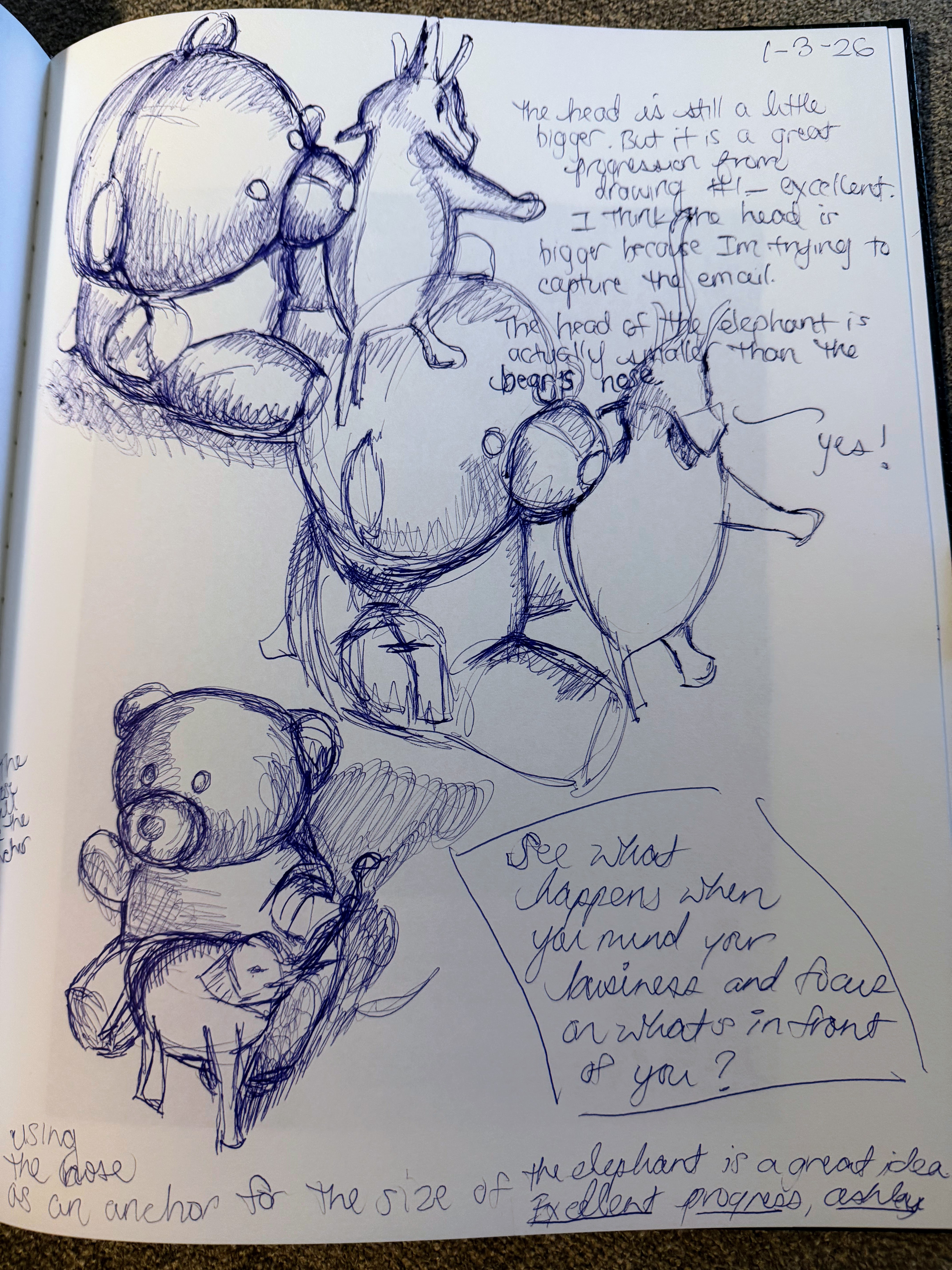
When I was in high school, I could not imagine drawing the same thing over and over. I would have perished. I just wanted to be done when I supposed to be, so I could move on and do the next thing. But recently that has changed. These last 9 days of drawing have shown that drawing the same object from different perspectives – and several times – has many benefits. Several artists recommend this. And I took their advice.
Not only am I looser when approaching the next iteration of the drawing, but also I’m more curious. I shift from drawing what I think is there to what is actually in front of me. I identify my anchor (point of reference for proportions) and draw what I see in relation to that point. The picture below is where I started with drawing two objects next to each other. The bear’s nose was my anchor.
I kept drawing and incorporated a brilliant piece of advice from artistKesh that immediately improved my experience. He advices to take 30 seconds after drawing to give yourself feedback. I made the notes and kept at it.
It wasn’t until the last drawing that I realized I was drawing the elephant larger than it is in proportion to the bear.
A few days later, I tried another angle of the bear and the elephant. It was very satisfying to draw with more ease, better proportions, and fun lighting.
Giving myself the feedback is so much fun. It’s a great way to acknowledge myself in the process. The self-acknowledgment is also retraining my turbo-stressed adolescent artist to relax and enjoy the experience. I can feel her delight within me.
How are you acknowledging yourself at the start of the year with your creativity? Do you feel that spark radiating with more joy? Or are you feeling other emotions. Leave me a comment below. And don’t forget to share your learning experiences with the young people you care for. It can really shape them for brighter possibilities.
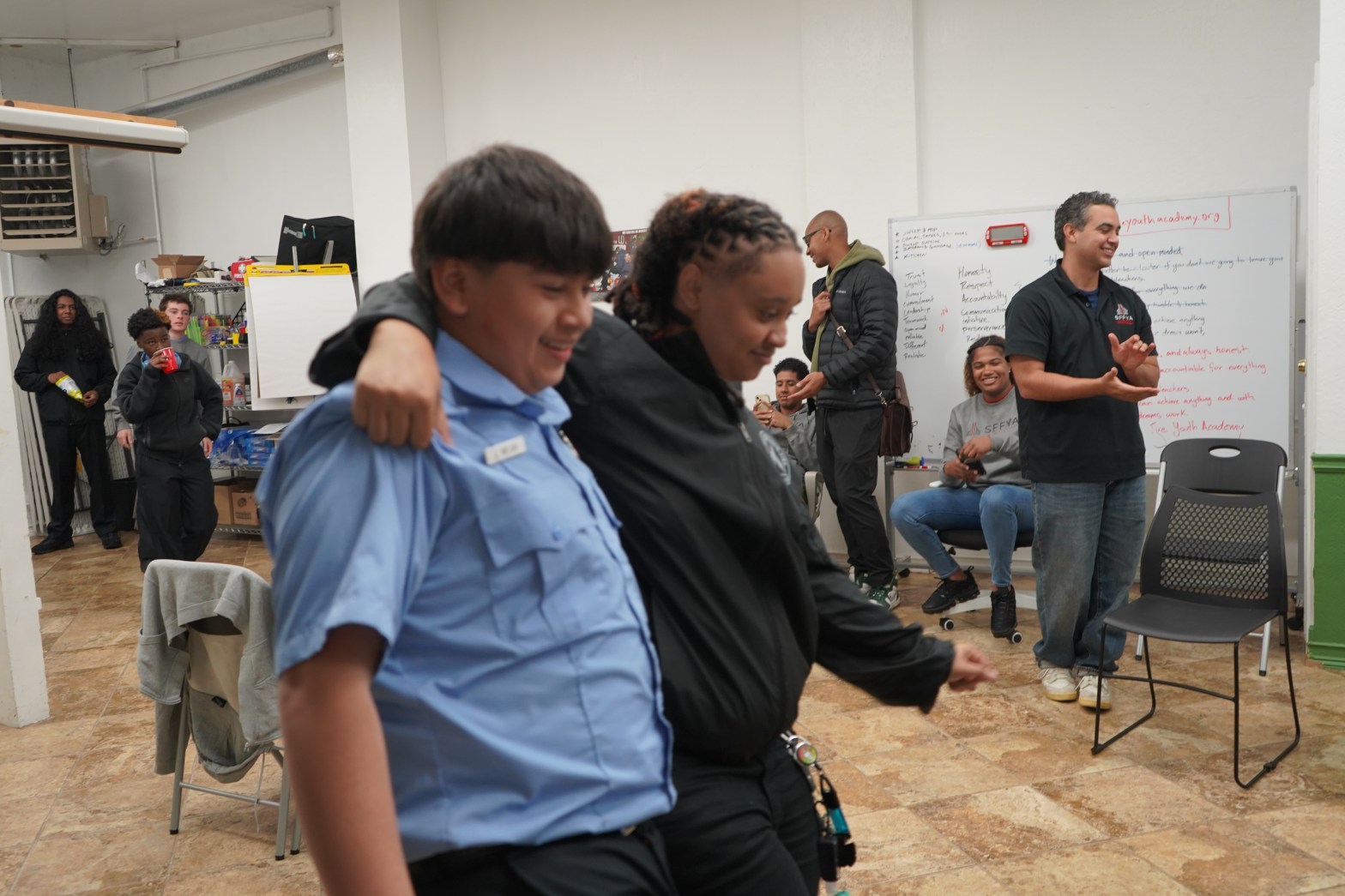
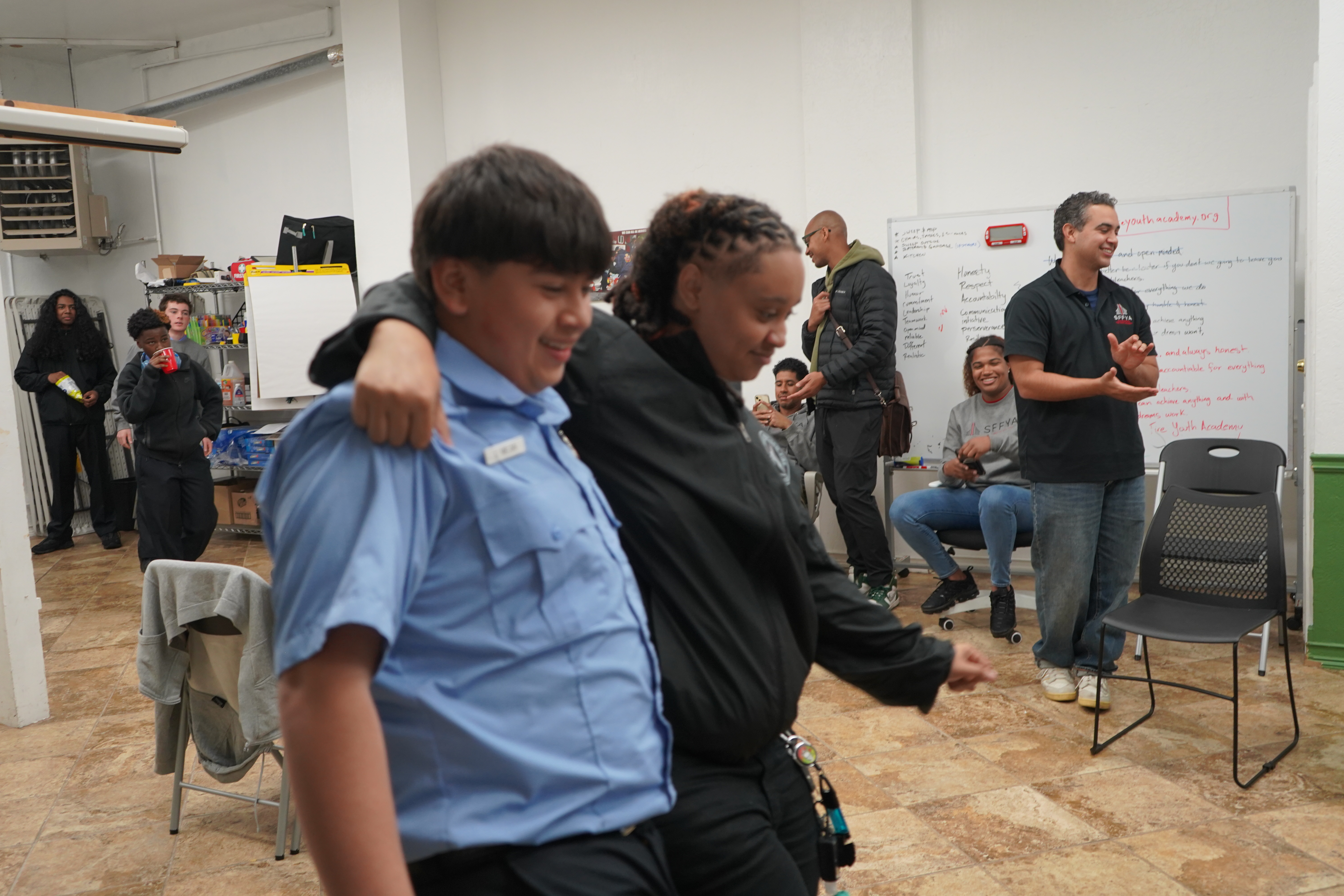
I remember reading the surveys of my students after a youth mental fitness class in San Francisco, CA. For the emotions check in and check out portion of the survey, I noticed that one of the students had written the emotion “triumphant.” On another occasion, a student (perhaps a different student) answered how he was feeling. He answered, “triumphant.” What a grand emotional state to find oneself in!
You may wondering, “Where did he find that word?” It’s on some of the emotions wheels I give young people to help them identify their emotions before and after a group coaching session. Perhaps the student would have answered this way without seeing the word an option among many. But I can’t help but to think having access to that word at his fingertips enhanced his emotional self-awareness. This is the power of vocabulary. Simply having access to words that describe our attributes and emotions enhances our lives.
Building vocabulary can be so much fun! You can create a game out of finding synonyms, using a thesaurus. You can make a treasure hunt out of searching for objects starting with the letter ‘A.’ The possibilities are nearly endless. When we help our kids build their vocabulary, we’re helping them build their lives. There’s no better time than now.
Decision making is a part of daily living. It heavily influences our internal lives and deeply affects the quality of our external lives. Children and adolescents are not exempt from this part of life. They, too, make decisions about their actions. And many teens, believe it or not, struggle with decision-making. Several teens I work with express wanting to know more about which decisions to make in life. The scary part is often not knowing which decision to make. But the more we model making decisions with self-awareness, the more proactive we become in teaching our young people how to decide, not just what to decide.
Don’t Wait Until Something Happens to Teach Or Preach Decision-Making
Instead of waiting until the kids have done something we don’t want them to do to teach them about the importance of decision-making, let’s be proactive. We can teach our kids how to make decisions simply by modeling and making room for them to make decisions.
When we make room for their voice, we make room for them to expand. Some kids shrink in the decision-making moment simply because they are not accustomed to that level of responsibility. The great news is that the human brain is adaptable [1]. Conscious decision making as a habit makes the brain more adaptable for deciding in extended contexts.
If you have a child who is timid or doubtful in their ability to make decisions, try the following activities with your child.
Make room for their verbal input on decision making that involves them and is appropriate for them to give input [2]. Stick with what you have already decided is appropriate for them to give input. If you want to explore or expand, here are some ideas. For older kids, this includes but is not limited to where they attend school, what internships they explore, what clubs they attend or begin, and how often they complete tasks at home. For younger children, this includes but is not limited to what they would like to wear, with whom they would like to have a play date, and what types of rewards they can earn for demonstrating integrity and trustworthiness. When you make room for their voice, you show them how much you care.
Start with small decisions. If your child often expresses or displays paralysis of analysis, limit the options to two or three. A third option helps young people expand their thinking beyond two options, which could help them speed up their decision-making time due to a third option.
Request your child to decide within 5 seconds. Many of us are familiar with the behavior science made popular by Mel Robbins, which includes starting a task within 5 seconds of having the thought to do the task. Applying decision-making to the 5 second rule trains children and adolescents to trust their ability to decide.
Demonstrate the process of deciding. Your consistent example encourages your child in the long run. Narrate your thinking in front of them so they have an audible representation of your thoughts. When deciding, don’t get caught up in all the outcomes of the decision. Focus on making the decision in the moment. You can assess the outcomes later.
Distinguish between small significant decisions and simply small decisions. Both matter, but in my experience, one applies to creating the overall quality of life versus the other affecting the quality in the moment. A small significant decision can be deciding to tell the truth when it’s unwanted or uncomfortable. A small significant decision can be standing up for someone being mistreated versus saying it’s not your business. A small decision could be what type of cereal to pick in an aisle full of variety. A small decision could be to wear the black sweater on a cold day instead of the gray one. Ultimately, you will decide how to distinguish between small significant decision and simply small decisions. Your values and core beliefs will lead you.
When we are presented with conflicting choices, regions in our brain activate. They include the Dorsal Anterior Cingulate Cortex and the Prefrontal Cortex [3]. Make room for your child’s voice while modeling your own decision-making, and you will strengthen the neural pathways associated with these regions in your child’s mind. You will also strengthen and create new neural pathways in your own mind. This is the beauty of neuroplasticity. Before you know it, you and your children will grow together, building the muscles required to assess, prioritize, and decide together for extended contexts.
We won’t be able to teach our kids what to decide for every moment of decision – and that can be daunting. But we can teach them how to alert themselves to their power to decide [2].
Little decisions stacked on top of one another create greater confidence in young people. They also create confidence in us as adults. In this context, confidence that comes from decision-making competence is rooted in repeated experience. Imagine a world full of competent, confident people working together. Their confidence comes from building the muscles required to assess, prioritize, and decide. Let’s keep building this world together!
More Resources
Looking for more ways to help support your child’s confidence to make decisions? Check out A-Maze-In Me, my self-discovery course for teens: https://a.co/d/irNV3MY
Steffen, P. R., Hedges, D., and Matheson R. (2022) “The Brain Is Adaptive Not Triune: How the Brain Responds to Threat, Challenge, and Change”Front Psychiatrydoi: 10.3389/fpsyt.2022.802606
Have you noticed a parent striving to meet everyone’s expectations, yet her attitude isn’t always pleasant? She’s depleted of her energy and teetering towards feeling defeated by the demands of life. You want to uplift her, but she is in an activated parasympathetic state. She’s tired, overstimulated, and encouraging herself with phrases like, “You go this, mama. Just keep pushing.” But she’s also a little doubtful. Not of her own abilities but of if she can meet the demands and be the loving presence she truly desires to be. She’s not alone. I’ve been there too, and I’m not a mother or a wife yet.
As humans, and especially as women, we give until the last drop. We hold everything together until we can’t hold anything else. I’ve seen beloved women in my life holding things together until they couldn’t. Two of them are my Mother and my Auntie Bob. I remember seeing them stand before their kitchen sinks completing tasks in an awkward position. They had the same mechanics. It was quite fascinating. I was an adolescent when I noticed the stance and asked, “Mom, do you have to use to restroom?” She answered yes. “Mom, go to the bathroom!” I saw my Auntie do the same thing on a different occasion in her own house. I also told her to go to the bathroom. She laughed and asked me how I knew. I told her about her sister. 😊
We know that like them, women hold more than their visits to the restroom. They hold memories, emotions, expectations of themselves and others all while trying to do something different to create a different set of life outcomes for themselves and their families. One of the more concerning parts of getting to the point of holding everything is that we are not always accessible to being held. Many times this is because we’re doing all the holding. Our breaking points can be minutes away. But our breakthroughs are there also. If you can relate, I want to encourage, one woman to another. If you’re a man reading this, it applies to you and your little boy as well.
Stop trying to make your little girl proud. She’s already proud of you. And so is your inner teenager.
Take brain breaks off your phone. Light a candle and watch it burn. Walk outside. Breathe in some fresh air. Listen to the sounds around you. Take in the colors and the smells of flowers. Relax your shoulders and simply breathe. You are worthy of your time and your attention.
When your children are seeking for your attention, and you feel like you’re at your limit, look into their eyes with softness and stillness. Simply be at your limit and love your child with eyes on them. Take a break with them if you can. Otherwise, take a break as soon as you can.
Let yourself be held. Whether it be your spouse, your children, your close friends and family, or the Spirit of the Most High, let yourself be held. It will soften your heart and strengthen your mind.
Practice knowing that your love is felt beyond meeting the demands of life and the people around you.
The bottom line is that you want your love to be felt. I know because when I’m doing everything I’m doing, I want my love to be felt as well. The truth is people know your love is there. They will be able to feel it more as you incorporate rest and enjoyment into your every day. When you come to your limit, stop and rest. Rest is designed for us to reset, regenerate, and renew for the morning.
Interested in giving more and spending less by doing an activity with your children? Check out my YouTube Video here.
Challenges that arise during homework time can quickly become a threat to a highly sensitive child or adolescent. She perceives that she is not equipped to address the demands of the assignment. But her perceptions are not necessarily true. She has to learn how capable she is, and perceptions don’t always see the outcome. There’s a tug between the top-down processes and bottom-up processes in her mind-body. [1] Her thoughts of incapability create physical discomfort and emotional turbulence. Her brain begins to shift from higher-level thinking skills into an activated sympathetic state. What is downshifting? It is a psychophysiological response to threat, a term originally coined by Geoffrey and Renate Nummela Caine in the 1990s. [2] How do we help this child, and many like her, upshift to relaxed alertness for learning? [3] Today’s tips can help you create the environment for putting a spotlight on errors so that kids can see them and correct them with ease.
Reduce overwhelm with sincere validation of effort. Children and adolescents need to know their effort is worth the input. Living in a society that values speed and flawlessness over slower paces and blemishes puts pressure on young people in more way than we know. If your child is not receptive to your validation in the moment, simply sit next to him with your vibrant presence and attentiveness. Don’t take anything personally. Learning and growing can be tough. If your child does not prefer you to sit next to them due to their emotional state (which I have seen), give them space and grace.
Tell your child you want them to show you where an error was made. The child may or may not know where they have made an error. You can assist your child in detecting the error as you would a treasure hunt. For every error they find, you can give them a non-food or non-screen-related treat. This can be very motivating. If the young person is working through a multistep mathematical problem or a science and engineering experiment, she may need to work backwards to detect the error. Thinking and speaking aloud in the reverse is extremely helpful for cognitive flexibility and problem solving. When the error is found, simply state with light-heartedness, “Oh, you can fix that!” Have a no-biggie (no big deal) response.
Watch your child make corrections with calmness and peace. Your emotional state can be felt. If you see another error, ask your child him if he sees any more errors. If he doesn’t see them, let him work through the problem towards the solution. Do not quickly point out the error because in doing so you are removing the opportunity for your child to detect errors and correct them. If your child learns at a different rate or in a different way, encourage your child to slow down so the error can be detected. Use the strategies you have that best support their learning.
When spotlighting the slipups, treat them lightly. After all, they are part of the learning process. Highlighting errors can be daunting. Nevertheless, it is very brave and essential to personal and academic growth. You can prepare your child for a “spotlight slipup” by telling them ahead of homework time that you will help them spotlight their errors to sharpen their skillsets. Spotlighting the slipup not only increases emotional agility but improves mastery. [4, 5]
Sources:
Mattson, M. P. (2014) Superior pattern processing is the essence of the evolved human brain. Frontiers in Neuroscience Doi: 10.3389/fnins.2014.00265
Caine, R. N., Caine, G., McClintic, C., and Klimek, K. J. (2015)12 Brain/Mind Learning Principles in Action. Corwin 2015.
Hammond, Z. (2014) Culturally Responsive Teaching and the Brain: Promoting Authentic Engagement and Rigor. Corwin.
Baniel, A. (2012) Kids Beyond Limits: Breakthrough results for children with autism, Asperger’s, brain damage, ADHD, and undiagnosed developmental delays. Penguin Group USA.
Today’s youth have the ultimate experience of opting into comfort. They can order almost any item they can afford from the phones without having to leave their location to receive their order. They can ease out of tolerance-building discomfort (those found in physical education, the arts, and sports) with claims of pain and injury. They can ditch discipline and commitments as they default to using language that describes attention deficits, neurodivergence, and the quality of the examples they have in their immediate environment. But what happens when these young people graduate high school and enter the workforce? What will their love ethic and attentiveness to life look like? Will they begin in satisfying careers with the skillsets to pivot into more advanced positions? Or will they settle for what is available given their capabilities?
Every generation gives birth to “the haves and have nots.” The developing “haves” are the ones who lift the cognitive loads, apply the emotional intelligence, go the extra mile, and set boundaries with their language and media consumption. They discipline their hearts and bodies to contribute to the wellbeing of their families and communities. They’re imperfect. Yet, they seek not perfection. They seek wholeness.
What are some meaningful ways to bring these young people into their present moment?
Purse what interests your teens with them. The time you actively spend with your child enjoying them positively impacts the emotional quality of their autobiographical memory.
Listen to the why that drives their desire to succeed. On the contrary, listen also to the motivations that interfere with their pursuit of personal growth and fulfillment.
Lean into the moments you discover your child’s behavior differs from your expectation of your child. Hold yourself with self-compassion while you hold your child in love. Identify the emotions you experience as you listen and take those to your Creator in prayer. Address the event accordingly.
Co-create experiences with your child that generate mutual understanding, respect, and deeper appreciation.
Be steadfast. Don’t give into doubts, worries, impatience, and frustration. Don’t give in because your children want you to win.
Don’t leave them to their devices to figure out the questions you refuse to answer. Seek guidance on how to skillfully answer. Teach them how to use what you give them – especially their phones. Laugh together. Cry together. Pause together. Solve problems together. Rest together. Though anxiety is on the rise, love that is reflected in truth and training can uplift the mind and heart, loosening the grips of distress.
Coming next: “How to get those teens moving when they don’t feel like it” and “tips for keeping your child safe online and in person.”
Children with bursting lights of energy are full of ideas. Those with verbal capabilities can express their theories regarding the conversations and behaviors of children and adults surrounding them. They have ideas for how things work together. They also have hypotheses about why things may not work together in different contexts. It’s quite fascinating. These same children want to test their hypotheses in the process of answering a question on their homework assignments. While their desire to experiment and iterate is honorable, getting them back on track to complete their assignment can be difficult – and even exhausting – for some parents. Today’s article will help you assist your child to get back on track during homework time. But here’s the thing: the solutions I offer in this article are not quick fixes to attention differences, daydreaming, “avoidance rituals,” or “stalling procedures.” My solutions honor the child and the adult working with them. They also require forethought and consistency. Every tip I’m offering you, I do with my students.
Let’s get into them.
Play a pre-homework game of chaos, rigidity, and calm.
It’s like Simon Says, but the children (usually ages 6 to 8) show you what chaos looks like, what rigidity looks like, and what calm looks like. This is very important because it helps them practice shifting gears physically, which is a manifestation of cognitive flexibility. Cognitive flexibility aids children in exploring alternatives to reaching their goal. [1] This activity also relies on self-control, a very important skill and attribute for reaching goals. [2] Shifting between the movements helps children build internal self-awareness. With internal self-awareness, children pair self-control with self-knowledge to create results [3]. At 6-, 7-, and 8-years old, many high-energy children are still learning what the movement differences feel like in their bodies. Knowing the difference helps them to be conscious of their movement.
Use the pre-homework game warm-up to help kids practice getting back to center during homework time.
When your child is aware of the different states, you can use the name of these physical states to draw their attention to their bodies and reactivate for the task. For example, when your child starts to talk about doing something else while doing homework, call a brain break. Tell them to show you chaos. Chaos is totally wild and gets the energy out. Rigidity is stiff. They can pretend to be frozen, a dead bug, or a dry noodle. Calm is peaceful. They can show you their moves. I demonstrate rowing my boat gently down the stream. When you see them getting wiggly, name it and tell them how much time you have left before homework time is finished. Remind children they are “running towards the finish line.” It’s an encouraging reminder for them and for you.
Take note of the statements your child expresses when they are veering away from the homework topic. Writing down what they say helps you to prepare a response that is thoughtful, immediate, and effective. The more you prepare, the more effective you’ll be. You know what your child needs to hear to get back on track. But if you’re using too many words when redirecting, use less words. I also recommend using “let’s” statements. These statements include but are not limited to, “Let’s stay on track.” “Let’s focus for the next 6 minutes.” “Let’s slow down and understand the question.” Using the word “let’s” signals co-learning and a shared experience to your child. It’s emotionally enriching.
Limit unrelated questions and answers to 120 seconds to teach prioritization and task completion. When your child is recalling information and connects it to the homework, she may say something like, “This reminds me of…” Ask her what it reminds her of. Remember, we want children to practice remembering. (See my last article, Power Up for Homework Time with Pre-Homework Conversations.) Like ours, their brains seek patterns and generate patterns while creating meaning of the content. [3, 4] If your child says, “This reminds me something my teacher said,” let her expound. Ask what and when questions to help memory recall. It could help you complete the homework.
Observe your child when he says, “What if we try it this way?” Give him one or two minutes to show you this idea if your patience permits. The idea may relate, and you could be pleasantly surprised. You can also ask, “Will this help us complete the homework? Or will it take us off track?” This type of inquiry helps the child consider the value of his solution as it relates to the homework. Their effort to answer is a demonstration of higher-level thinking development. Affirm that you want to hear his idea, but you want to complete the assignment first. That way, he can share afterwards.
My next article will help you help your older children in middle school and high school build self-awareness and cognitive flexibility with physical agility exercises.
Sources:
Wang, S & Aamodt. S. (2012) Welcome to Your Child’s Brain: How the Mind Grows from Conception to College Bloomsbury USA.
For many families across the United States, homework time is an evening must-do that, if not completed at school or the afterschool program, is an eye-rolling event during dinner preparation. “Only a few more years before they’re completing this on their own,” adults utter internally between the sighs of their patience. While a “a few more years” isn’t long from now, it’s quite a time to labor with printables and last-minute projects.
The good news is that you don’t have to wait to improve homework time with your child. The information and tips in today’s article can help you maximize any time of learning so your child can increase their enjoyment and improve their information processing. You also get to enjoy them even more.
Before you start homework, start with what is already known.
Homework time goes faster when the child is actively thinking about the concepts and can draw coherent connections between known concepts and new concepts. To get them actively thinking about concepts, set up pre-homework time with an intentional conversation. Pre-homework time plugs kids into what they know so they can complete the assignments in front of them.
Ask your child to communicate in a few sentences what they know about the subject in which the homework was given. Providing a brief summary of the concepts being learned and explaining the connection to the homework assignment demonstrates effective memory recall. Simply talking about what they are learning activates their memory recall, connecting current knowledge to existing funds of knowledge. If your child cannot remember, that’s okay. Practice remembering. When children practice remembering, their brains light up neuronally with connections strengthening between the hippocampus and the cortices involved in the perception of the information [1, 2].
Get your timer ready to make it a game after the child has explained the concepts to you the first time.
Once your child has completed summarizing what they know, ask questions that link what they know to their homework assignment. Have the young person explain their reasoning once without a time and twice with a timer to improve time-aware thinking and speaking. A child or youth who can do this has proven that they are highly proficient in the subject because they have consolidated the information and internalized it coherently. This is exactly what we want children and youth to be able to do. It shows us adults that young people are actively processing the concepts they’re learning. Active processing is a brain-based learning process that improves outcomes. [3] Acknowledge emotions as they arise. But let them speed bumps rather than roadblocks for expression.
The benefits
You invigorate your conversations with curiosity and enthusiasm, two emotions that positively influence your child’s autobiographical memory. [4]
You reduce emotional dragging and procrastination by energizing yourself with curiosity, enthusiasm, and a timer.
You get to see your child in educational conversation action and shining that brilliant light.
Your child develops a variety of skills that strengthen executive functioning for academic success.
Your child increases their emotional self-awareness.
You and your child create another memory that will make you smile.
Stay tuned for the next article where I will share ways to help second and third graders stay on topic when they have so many ideas to share during homework time.
Sources:
Seigel, D. & Payne-Bryson, T. (2011) The Whole Brain Child:12 Revolutionary Strategies to Nurture Your Child’s Developing Mind, Survive Everyday Parenting Struggles, and Help Your Family Thrive. Random House Publishing Group.
Degen, R. J. (2011) Brain-Based Learning: The Neurological Findings About the Human Brain that Every Teacher Should Know to be Effective. International School of Management Paris.
More, K. M. & Rane, A. R. (2015) Brain Based Learning: Holistic Approach to Teaching and Learning. International Journal of Educational Research Studies. www.srjis.com
“I just don’t like this!” One of my students vehemently confessed in frustration.
“What don’t you like?” I asked with curiosity and slight concern.
“This.” He tossed a Word-A-Round card in my direction, expressing his disdain for the challenge.
I quickly put on my investigative hat and wondered how I could bring him back to the present moment, where he could access his calmness and ingenuity for problem-solving. He enjoyed new challenges and lit up as he discovered his solutions along the way. I also saw him ride his emotional waves and come back to the task ready to succeed enough time to know this moment, too, would pass.
However, this moment was faintly different.
Not knowing the answer, now having the answer, and not knowing how to obtain the answer were causing his brain to downshift. Downshifting [1], a term coined by Geoffrey Caine and Renate Nummela Caine, is a psychophysiological response to threat. The threat was not knowing the answer and not knowing how to obtain the answer. To be specific, my student didn’t know how to decode the words because they are written in a circular direction, which is not typical to the way we read words. The very act of having to decode words that appeared to have no beginning or end caused an automatic shift in his attention. His emotional response was a sign that his energy from his higher-level thinking skills, those housed in the prefrontal cortex, were being drawn away.
You may be wondering how I found out what was specifically frustrating him. First, I affirmed that I knew he could read, but reading words in this format is new. Second, I asked him to tell me specifically what he did not like about the activity. “This” – his response to my initial question – had to be unpacked.
There was a silence between the question and the answer. I had to be patient. He couldn’t access his words because his stress had been activated, and he needed to ground himself physically to release tension before verbally responding. I couldn’t’ rush the process.
Children cannot learn efficiently when their brains downshift. Not knowing the answer, not having it, and not knowing how to obtain it can be very stressful for children and youth because they think they should know already. They also think they should understand quickly. If they don’t, too many assume, “something must be wrong with me.”
So, how can we help kids upshift into learning to expand their capabilities?
Notice when your child’s emotional state is changing because they are experience academic difficulty. Emotions have a molecular and physiological basis [4]. Downshifting happens without conscious awareness [3]. Even if your child looks like they have a habit of downshifting, it is sign that they need better coping tools when lifting cognitive loads. It is a not a sign that they should stop putting in the effort completely and that they’re not “cut out for academic.” They are cut out to excel at what interests them. Let’s help them discover that.
Get out of the brain when it downshifts by getting into the body. Once you notice the change happening, mandate a break. Shake out the anxiety. Ride the happy horse. Bounce those shoulders to loosen them up. By moving, we quickly shift our state and reset the body into the present moment.
Some children and youth prefer not to take a break until they have accomplished a certain level of their work. There are a few options. One is to set a timer into taking a break. You can let them work until they can’t work anymore if they are completely adamant about finishing. You can also playfully initiate a break by doing some silly aerobic exercises that put a smile on the child’s face. Tell them to join you. I also make teens join me by annoying them until they join me. The reward in that moment is they’ve taken the break and I’m out of their face. They reset and get back to work.
Try the first me- then we- then you model. I put my finger on each letter and read aloud the letters to determine if they make a word. I do this until I decode the word. Then, we do it together. Then, the student does it with me watching.
I model rotating the card as an example for the student so that he or she can see my thinking and approach process.
Emotions are not separate from cognition [1, 4]. Emotions and cognition are interconnected. With the knowledge of what downshifting is and tools for getting back on track, you can help your child enjoy challenges and reach new heights.
Sources
Caine, R. N., Caine, G., McClintic, C., and Klimek, K. J. (2015) 12 Brain/Mind Learning Principles in Action. Corwin 2015.
Steffen, P. R., Hedges, D., and Matheson R. (2022) “The Brain Is Adaptive Not Triune: How the Brain Responds to Threat, Challenge, and Change”Front Psychiatrydoi: 10.3389/fpsyt.2022.802606
The ages at which children and youth begin to realize their parents are not really superheroes vary from child to child. But there is something notable about parents and guardians who demonstrate the power of addressing conflict. Instead of avoiding it or denying it, they collaborate with trusted family and friends, devising short-term and long-term solutions along the way. They even seek professional support. Who needs fictitious superheroes when the adults who care for you work through their problems, providing ongoing example of how it’s done?
Today, I want to remind you of how important you are to your children. How you handle conflict – the internal and external ones – can be a mirror in which they see themselves for years to come. While they may not know the details of what you’re going through, how you go through becomes their compass for future dilemmas. Don’t give up. Don’t give in. Your children want you to win. Don’t give in to the doubts, worries, frustrations, and impatience you experience. Acknowledge them. Name the source of those emotions. Decide to make a decision about what is in your control. Keep rising up. Your healing presence has a beneficial neurophysiological effect. Your warm emotional tone has an uplifting psychological impact. You matter. So, stay the course.
While there are many conflicts young people will hear of or witness that are out of their control – and outside of their parents’ knowledge – there are conflicts that give young people confidence in their own ability to resolve conflict. These are the conflicts they see their parents work through. Even the internal conflicts you face and overcome with daily practice reward your child mentally and emotionally because they get to have you – and they love you so much.
So, don’t give in! Your children want you to win. The people who love you, ask about you, pray for you, and check in on you want you to win.
Decades of research show that the way parents organize and process their emotions help children processing and organizing their own emotions. The practice of processing and organizing not only strengthens cognitive abilities for better mental performance and healthier relationships, but also it nurtures the vitality of the immune and cardiovascular systems. Research also shows that repeated social challenges in a child’s environment can disrupt basic homeostatic processes that are central to the maintenance of health (McEwen & Stellar, 1993). One might conclude that repeatedly overcoming social challenges in a child’s environment can strengthen the homeostatic processes that are central to a life of vitality.
Stay encouraged. I want you to win! You are here with a purpose. Don’t let any source of news or any source of stress carry you from the truth of why you are here. My next few post will help you unlock the productivity of your struggles so you can boost your mental performance and experience more joy.
Until we meet again,
Ashley
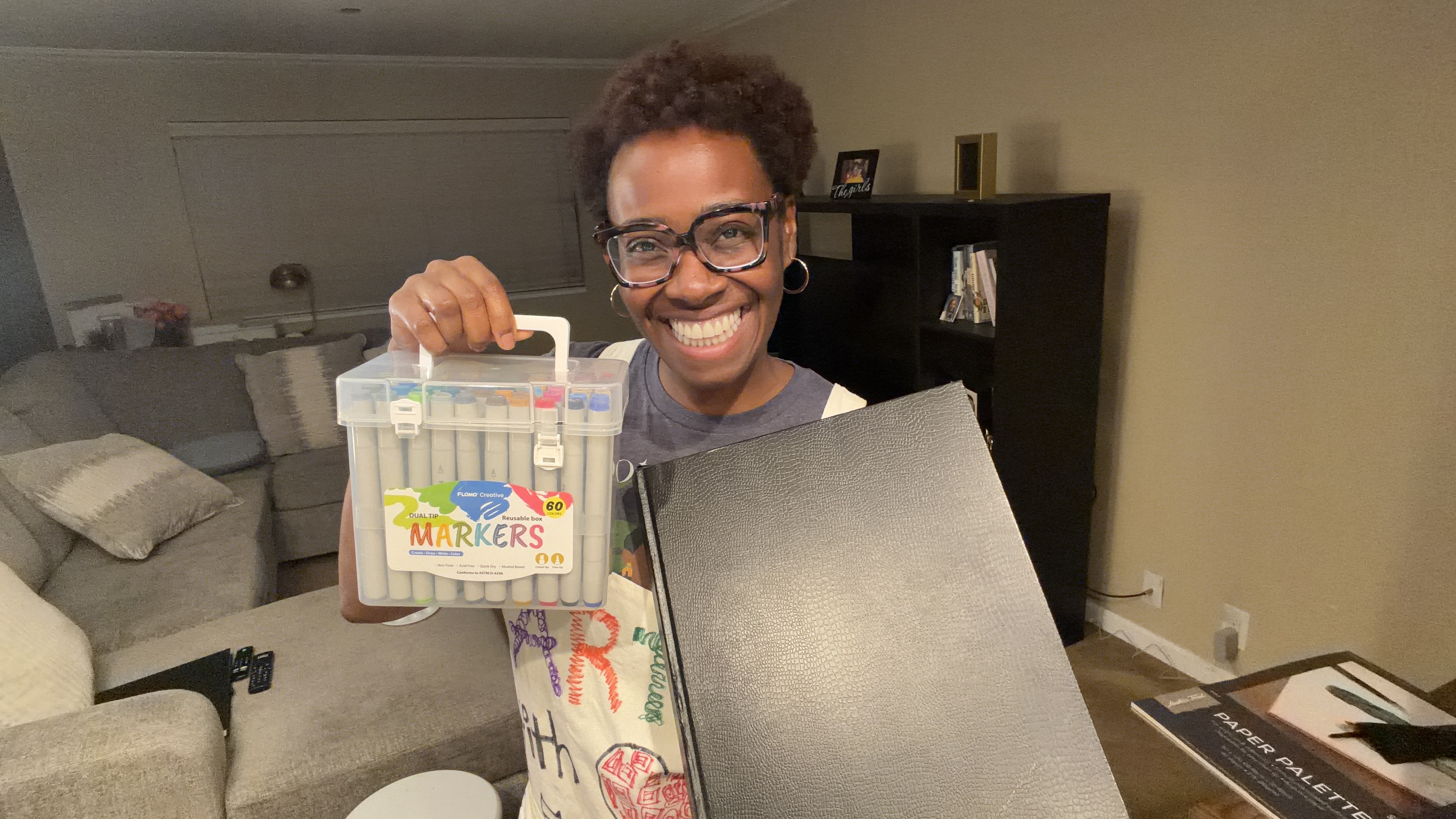
Ashley M. Blanco serves as a Kids Life Coach, Educator, and Author in the San Francisco Bay Area. She helps children and youth improve their confidence and mental performance through gamified personal development. Listen to her Perspective on KQED Public Radio: https://www.kqed.org/perspectives. Learn more about her impact at https://www.risewhereyouare.com/
Sources:
Gervais, C., & Jose, P. E. (2020). How does family connectedness contribute to youths’ health? The mediating role of coping strategies. Family Process, 59(4), 1627-1647
Repetti, R.L, Taylor, S. E., and Seeman, T. E. (2002) Risky Families: Family Social Environments and the Mental and Physical Health of Offspring. American Psychological Association, Inc. 2002, Vol. 128, No. 2, 330 –366 0033-2909/02/$5.00 DOI: 10.1037//0033-2909.128.2.330

















 Ashley M. Blanco